This article is the first in a series on 'Quest For Innovation' . In this article we examine the perspectives lying at the root of Innovation.
Just imagine the nomadic man , standing on top of a hill , with a basket of fruits. His legs ache because he has made many trips to the top of the hill to carry the fruits down to the base of the hill. He sees some logs nearby. He puts them together ; keeps his basket on top of them and rolls them down the hill. The logs roll for some distance and then the "Basket of Fruits" falls down.
Idea failure ! Dejection ! weariness engulfs the nomadic man. Was the idea a failure ? No ,the Idea was the seed of the subsequent Innovation called the "Wheel" which became fundamental to the locomotion of humanity. Hence , even if one's idea seems small , at the moment, it may multiply into something big.
The above Innovation Pattern has replicated itself continuously to enable the "growth of humankind" , resulting in its ability to fly through the air ; subjugate almost all animals ; go to the moon ; live in large social groups called Countries and so on. Looking at Innovation from another angle , we observe that Innovation has a positive correlation with economic growth , organizational growth as well as personal growth.
Just look around , in poor countries , we find a distinct lack of Innovation and the lack of processes to support it.On the other hand , when we look at the rich countries , we find that "Innovation" is ubiquitous and these countries have created specific processes to support it.
Taking cognisance of the link of Innovation to humankind's survival and growth , it is surprising that the focus on it is rather limited. How many organizations or countries have an "Innovation Policy or a strategy"?
In the universe everything is in a state of flux. A system starts deteriorating as soon as it goes into equilibrium. Therefore , if we don't innovate , we are bound to decline.
Can Creativity or Innovative ability be developed or is it inborn ? This question seems to be pre dominant in most people . This is the single most detterent in the path to becoming creative individuals. The Common Logic that prevails is , "Creativity is generic . So , let's get on with our work.No point in trying to change something which cannot be changed."
Creativity and Innovation are skills . The Organizations and people who have mastered them , are able to apply them repeatedly to generate Innovation . Look at Sony and 3M . They were innovative , they are innovative and they will continue to be innovative. During this entire time period , their work force has changed , but their innovation capability has not declined. Do they have some sort of a selection tool through which they are able to map the creative potential of a candidate ? Obviously not.
There obviously are a set of skills related to Innovation & Creativity. Let us try to extract these skills from a live example :
Ex: I-Mac ComputersI - Mac computers are successful innovations. If we examine Why , it comes to the fore that there is something new about them . What ? Their design. They are designer computers , while the traditional computers look stark and stodgy in comparison.
Then the following queries arise :Query : These computers are "New" with respect to" what attribute of other computers ?Answer : With respect to design of other branded computers.Next Query : Why are the consumers buying I-mac Computers ?Answer : They are nice , pretty , aesthetic , adding value to the room in addition to being fundamentally valuable.
From this example , the key aspects of Innovation and the corresponding skills emerge.
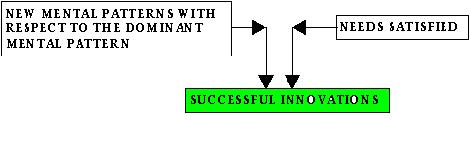 (Fig 1)
 The term "DMP"(Dominant Mental Pattern) emerges as one of the cornerstones of the Innovation Process . We have DMPs of every process / product . This mapping of the DMP of a product / process is the starting point of "conscious creativity or Innovation". The redesigning of this DMP is "Creativity". Let us examine a live translation of this process :
These are the elements of the Dominant Mental Pattern. In order to innovate , this DMP has to be challenged.
On challenging the elements "Brandnames written in Big Letters" and "Static" , we get the Innovation Trigger" Why not dynamic" . On developing this thought pattern , we get creative thought patterns such as:
On challenging the element "Lighted" we get the Innovation Trigger "Dark" or "Changing lights". On moving along this thought pattern , we get the mental pattern,"Brand Board " with the "brand highlighted through changing light colours"and " different light intensities".
These kinds of "Brand Boards" would attract more attention of passerbys because they provide "Additional Value" to the "onlooker" thereby creating more brand value in comparison to the bland "Brand Boards" currently prevalent all over the market place.
It is not necessary that every challenge of a DMP element would yield a creative idea. This is where "Flexibility" is required from the"Would be Innovator". If a certain Innovation Trigger does not yield an innovative idea , he / she needs to move on to the next and then the next and so on,without getting bogged down.
Moreover , the fundamental function of the Innovation trigger is to enable the redesigning of the mental pattern. Subsequently , if the original elements of the DMP need to be reintegrated , the Innovator should be "Open" to do so.
The DMP Challenge can be extended , by using another tool called "Frame" along with it. This tool simplifies and extends the process of challenging the "Elements of the DMP".
If we Fuse 2 or more elements of the DMP together or Replace 1 or more elements of the DMP with other element (s) or Add a new element to the set of elements in the DMP or Mutate one or more elements from the DMP , a new Mental Pattern gets formed.
For example , in the "Brand board" example , if we replace the element "Square" or "rectangular" with "Oval" or "Circular" or "Combination of standard shapes" or 'Product Shape" or "Shape representing Product purpose"; an Innovation emerges.
Hence , "Framing of the DMP" multiplies the potential of the tool , "DMP Challenge".