Presentation Skills
Author/Sanjiv Narang/innovationtriggers@hotmail.com
When you finish a presentation that is received well , it is like walking on a cloud 9 and when you finish a presentation that is not received well , it is like walking on broken glass.I have noticed that presenters tend to develop a pale & dark colour after a presentation has flopped.It is really a painful experience.Therefore, skill development in the area is worth the effort.
Additionally,the increasing amount of competition for the mind share of industrial buyers , is creating a premium on "PRESENTATION SKILLS" , in the skill inventory of a marketeer. Even for professionals in other functions , Presentation Skills become mandatory above the grass - root level .
This prompted me to examine some of the current literature on"PRESENTATION SKILLS". I found that except for a few exceptions , most of the current literature talks about the speaker , content (Style and Structure), audience and medium . Though this is relevant , it seems that the current paradigm of "Presentation Skills" has reached a saturation point. Therefore , in order to increase the effectiveness of Presentations , we have to Innovate.
Is there a model of an effective Presentation that we can develop, based on our experiential success and failure patterns.
An analysis of some significant presentations in terms of outcomes , yields clear patterns.Some examples are examined below.
I fixed up a presentation with a leading FMCG Co., with the objective of sharing with them the advantages of " Electronic Data Interchange " and the uses of Electronic Commerce.After sharing with them the basic concept , we were just getting into the details , when the materials manager said , "What exactly are you trying to sell ?"
We responded by specifying the EDI Software packages.
The materials manager then stated that such decisions were taken in the London Office. So , there would be no point in his responding enthusiastically to our suggestions and wasting everybody's time .
Lessons Learnt:
- Audience Analysis: The presenter needs to :
- Determine the decision - making power of the audience. If the decision is not in the hands of the audience and/or the audience does not have the influencing capability regarding the Product / Service , time is being wasted.
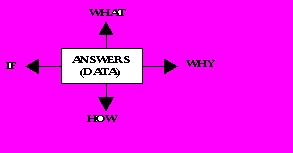
- Answers to "What , How , Why and If Questions:
- This not only increases the perspective of the audience as a whole , but also responds to the different dominant mental patterns in the audience , i.e Imaginators , Teamsters and Analysers.The answers to each of the questions What,How,Why & If create alignment with different expectations of the audience.The answers to 'What & How 'being the basic data needed;answers to' why' questions respond to the requirements of analysers in the audience & the answers to 'If'questions respond to the requirements of imaginators in the audience & also serve the purpose of creating positive future scenarios.
Quoting the case of another Presentation that flopped badly. This presentation was to Senior managers of a Heavy Vehicle manufacturer. Each of the Audience Members had 15 - 20 years of Professional Experience . The presenter was imaginative while the audience was full of hardcore analysers.
The Result: Audience found the presentation' Childish' . In the feedback the audience emphasized the requirement of case studies.
This further adds credibility to our earlier learning that the presenter should do audience analysis and adjust to the audience thinking patterns .Otherwise the presenter should be prepared with data to deal with the different types of audience members , i.e Imaginators and Analysers .
In another presentation , we sat across a table and talked . It was a question answer session . The session went well . Thereafter , they asked me for testimonials . Since , I was not prepared with testimonials , I was slightly hesitant . However , with a little bit of search , we were able to identify some references. The concerned organization never took the matter further.
LEARNING:
- Testimonials : Be prepared with data to support your claims , in terms of references and live data .
The data can be used to build up two kinds of reasoning :
- Deductive Reasoning: This is structured like a lecture , with the conclusion supported by logic and data.The conclusion is stated first followed by data .
Example: This is the fastest car (with visual ) followed by the description of the engine and the transmission that enables it to be the fastest. So , the movement of the logic is from overall description to specific points.
- Inductive Reasoning: The presenter offers data through examples and visuals , which trigger the formations of desired "Conclusions" in the minds of the audience. This involves audience involvement in the Inductive Reasoning Process.
Example: The presenter displays the visuals/data of a engine , transmission and gears that enable fast cars . Thereby , he / she shows the visuals of the Car consisting of the already shown components. Thus , the audience arrives at the conclusion that the car shown is a fast car.
In inductive reasoning , the presenter provides the data in terms of visuals and facts ; follows it up with verbal trigger to catalyse analysis of data by the audience , so that they move to the desired conclusions on their own .
A combination of Deductive and Inductive Reasoning creates potency in a presentation.
- Visuals :
Visuals are the life of a presentation.The first important point is that the presenter himself is the most important visual of the presentation.Visuals aid comprehension by whole-braining the presentation.They trigger the referent thing-in-the -world corresponding to a concept/word.If these visuals are accompanied with feeling/emotional data the potency of the message multiplies.
In another one of my presentations , the Head of HR said ,"I always ask the presenter ,' How are you different from the others' ? "
The subsequent analysis and synthesis of this question triggered the identification of the presentation success pattern of having a "Unique Selling Preposition" . This is where marketing skills begin to cross - fertilize with Presentation Skills.
LEARNING : USP
The presenter needs to clearly identify the Unique Selling Preposition of the Concept / Product / process which is the key focus of the Presentation. Thereafter , through Deductive and Inductive Reasoning , the presenter needs to catalyse the formation of audience mental patterns which are aligned to the pre - decided Unique Selling Preposition.
For example : In a sales enhancement plan for a travel agency we were trying to work out a USP to be used in presentations to organizations .We evolved the USP by examining the weak points of other travel agents & projecting them as strong points of the infocus travel agent along with integrating them into the work processes of the organization.
Comparing two presentations which I made to similar audiences . I did not make a good closure in one while I made a better closure in the other in terms of summing up the key points and mapping the future scenario in case of implementation of desired action . The audience feedback indicated a 5 - 10 % increase in positive responses.
LEARNING:
The closing of a presentation has a significant impact on its degree of success.
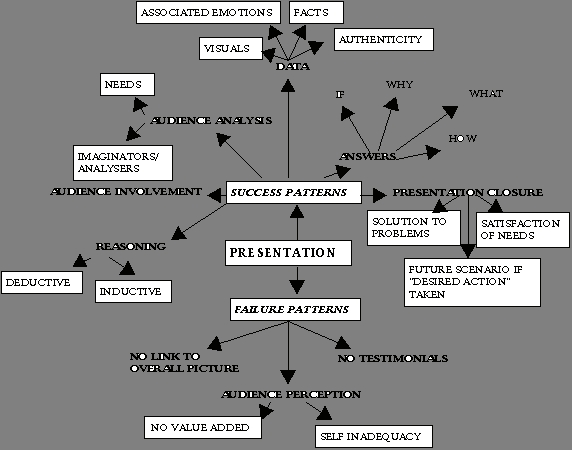
A consolidated map of the success and failure patterns of a presentation is given below :