 (Fig 1)
Communication , What a cliched term. It seems everyone has talked about it sometime or the other and everybody has been exposed to some sort of formal communication training at some time or the other.The thought of it evokes boredom and the thought of O that !Inspite of such a situation,it seems to be a paradox that we are plagued with animosity,lack of trust,lack of cooperation,snowballing criticism,misread intentions etc. at the work place & at home.
More often than not,the word Communication only evokes the thought patterns related to the "Communication Process" and "Listening Skills". The predominant perspective of communication being synonymous with vocabulary continues to hold sway.On examining and exploring the "Power of Communication" and the related "Communication skills" , this dominant perspective shatters easily.
In order to illustrate,let us examine the outcomes when different communication patterns are used.
Situation :
A boss notices one of his subordinates , continually in the canteen . He / She feels extremely irritated because work is pending.
Outcome: Subordinate feels humiliated ; nurtures bad feelings about his boss ; gets even by bad mouthing his boss behind his / her back.
Impact: The current problem may or may not get solved . This Communication Pattern creates aminiosity resulting in the creation of a bigger problem.
Outcome: The subordinate understands the reasons behind the feelings and statements of the boss.
Impact: Better alignment and understanding between the boss and subordinate.
Though the intentions of the boss are the same behind both the Communication Patterns , the result is dramatically different.
Why is Communication Pattern 2 better ? What makes it more potent ? Why are there no negative consequencies ?
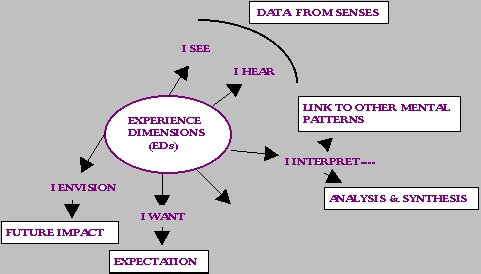
On analysing communication pattern2 , we discover that it is communicating 5 experience dimensions .
(Fig 1)
These EDs enable the transfer of mental and emotional patterns , which is the mind , body and soul of "Communication".
The cost of poor or inadequate Communication is enormous , in terms of misunderstandings , animosity , politicking etc.
Some other examples of using EDs for communication areas are as follows :
because you look like an angel . I want you to dress more often like this so that life can be more cheerful more often.
because it is a pity that people cannot appreciate the need for action in such situations . I would like you to continue being your cheerful and active self , so that these positive characteristics are not lost and unlearnt.
As one goes through the above examples , one can't help noticing and feeling the completeness of Communication and the satisfaction , it provides.
From the listener's perspective , EDs help to recreate the speaker's experience. EDs can help the listener to listen with 5 ears , one corresponding to each ED. Hence , if the speaker misses out any of the 5 EDs, the listener can trigger its transfer by asking an open ended question, such as :
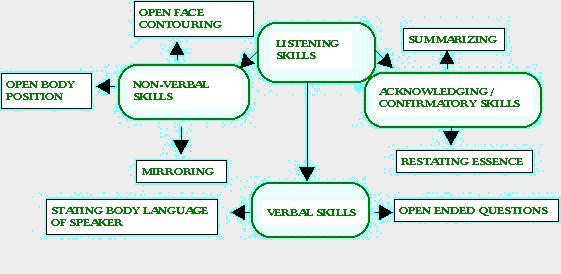
'Open - ended' questions are "Listener's Tools" to enable mental pattern transfer .The key potent listening skills are mapped in Fig2:
 (Fig 2)
As a listener , we need to distinguish between acknowledgement and approval / disapproval. A speaker looks for two kinds of satisfaction . One , he / she wants that he / she be understood and second that whatever is said should be accepted. Hence , we as listeners can provide 50 % satisfaction to the speaker by acknowledging what has been said . This acknowledgement can be in the form of communicating back to the speaker the essence or the summarization of the original message .
Speaker : I have withdrawn from these Innovation Projects . I am tired of seeing and hearing people talking about DSL , when our current focus is on selling TCP / IP dial up Accounts.
Listener: So , you feel that there should be a clear distinction between Innovation oriented work and the regular work that we have to do.
Speaker:Yes . (satisfied tone)
In this case , the yes spoken by the speaker smacked of "Satisfaction".
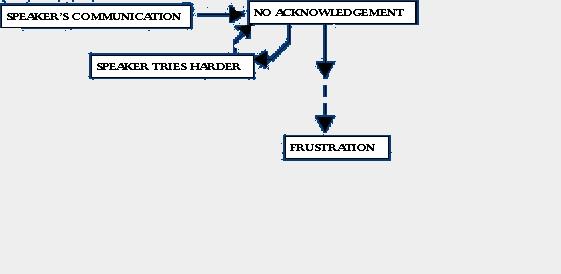
What happens when communication is not acknowledged ?
 (Fig 3 )
For the speaker , this leads to frustration and the feeling of hitting one's head against a wall.
Listening Skills on our part become all the more important , when we are facing 'criticism'. Generally when Person A criticises Person B , Person B tends to get defensive or in turn tends to criticise A. This can snowball into a download spiral of criticism. This results in visible discontent and no satisfactory outcome.
Person A: Your table is littered with stuff from all over the office . Can you try to be a little organized.
Person B: People from all over the office , use my table as a dumping ground , What can I do ? Even you left your papers on my desk 2 days back.
Person A: Your desk is always littered on all days.
This kind of interaction is dissatisfying. It , however , is omnipresent around us.
In order to avoid this "Downward spiral of criticism" , we need to convert'Criticism' into 'Action Requests'.
Person A: Could you please organize your desk so that information can be found when required.
On hearing such a request and the associated request explanation , there is a tendency on the part of B to do as requested. The generally visible "Criticism Battle" does not happen.
This skill of converting Criticism into "Action Requests" is a potent communication skill that we can use both as "receivers" or " Givers" of 'Criticism'.
Even if we adopt the above designed communication skills of EDs , Acknowledging skills or the converting of Criticism into "Action request" , there still may be a huge number of "Communication Gaps" because of misread "Communication Intentions".
Broker: Please send 3 Transfer deeds , so that we can use them , if one is not enough.
Client(feeling): Why does he require 3 Transfer deeds.
Client(Action): Okay , I will send 2.
Misread Commuication Intentions tend to snowball into huge communication gaps. In order to avoid such commumcation gaps,the speaker needs to clarify his/her intention & invite the listener's consent.
Ex.: Sir,I want to talk to u about our next month's plan.Do you have 20 minutes.
Clarifying intentions & taking the listener's consent serve the purpose of establishing the communication channel between the two parties.In addition it gives the opportunity to the listener to be a part of the communication out of choice rather than necessity.
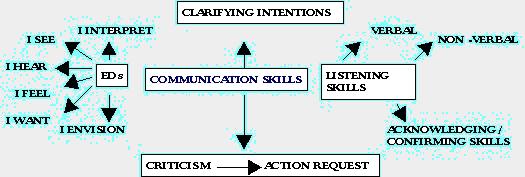
The key potent communication skills which enhance our "Power of Communication" are mapped in Fig 4.
 (Fig 4)
The impact of these skills is cascading and all pervasive.
Note : I am indebted to the writings of Dennis Rovers , which helped me explore and understand communication.