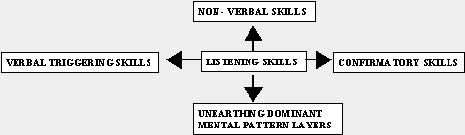
It was only when I comprehended the importance
of "Listening Skills" that I realized , why God gave us two ears and one
mouth . Research indicates that we spend about 40 % of our daily time ,
listening .
Therefore , it becomes obvious that any improvement
in this skill would have a direct impact on Personal effectiveness. Thus
, it is a paradox that it is not an integral part of any management school
curriculum or even the perception of HR Departments.
Relating a personal experience ," When I bought
a computer , in 1997 , the computer reseller was supposed to send a technical
service representative (TSR) to set it up. I went through the guide books
given as a part of the computer potpourri and had a large number of questions
, which I wanted to ask the TSR. The TSR arrived , went straight to the
computer, set it up i.e , put it on , told me that he was in a hurry and
pushed off.
I was left with feelings of queasiness and dissatisfaction.
The dominant mental pattern in my mind became ,"This reseller has poor
service capabilities ". On analyzing my own behaviour , I realized that
I was unhappy with the services in spite of the computer operating efficiently
and that I would try out other resellers , next time.
If the TSR had practiced listening skills ,
whether verbal or non - verbal , the outcome would have been certainly
different.
Prima-facie, it seems that the physical act
of listening is what listening skills are all about.However on closer examination
it comes to the fore that listening is an active rather than a passive
skill.
NON VERBAL SKILLS :
For effective listening , we not only need to
use our ears but also our eyes and emotional perceptions.
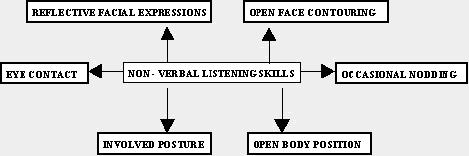
The non- verbal listening skills relate to facial
expression , body posture and giving the other person an opportunity to
speak.
The face has to be used as a tool for extracting
information . We need to listen with our faces. This would involve eye
contact , open face contouring ,occasional nodding of the head , reflective
facial expressions and an open body posture .These attributes indicate
mental involvement with the speaker thereby facilitating communication.
VERBAL TRIGGERING SKILLS
:
Though
the term "listening" connotes passivity , in reality it is not.
Verbal triggers are essential components of
a "Good listener" repertoirre of listening skills for enabling a
person to open up and visibilize his / her mental patterns. These verbal
triggers can vary from minimum catalysers such as "I see" to "open
ended questions".
"Minimum catalysers" can be utilized for egging on a person to share more
of his / her mental patterns. Communication invitations such as "What
is happening " invariably result in the sharing of the dominant perspective
by the focussed person. This trigger seems to be the most widely used and
accepted invitation to communication.
>
The
C.E.O of a leading textile unit uses a variant of this in the form of,
"What is the feedback" , to extract most of the soft information , in which
he is interested.
The creation of an "Expectant Silence " results
in an urge to fill the silence through speech , which invariably triggers
the visibility of situation specific perceptions. Body language descriptions
in the form of "You look tired, why ?" are also effective "open up invitations".
Each mental pattern layer can be the basis of forming open ended questions
such as , " What have you seen / felt / experienced that led you
to the conclusion that he is a miscreant".
OR
"What are
your assumptions when you say that his actions indicate his guilt ?" .
These
act as powerful triggers for accessing and visibilizing the relevant mental
patterns of a person.>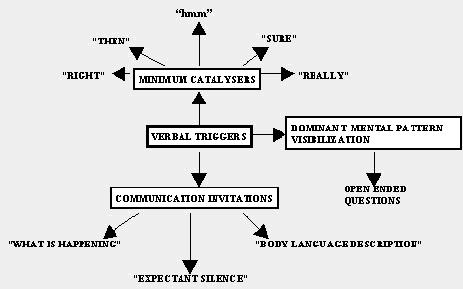
CONFIRMATORY SKILLS :
Many
a times when I have said something crucial to someone , I have wondered
whether the person has understood. This invariably prompts me to ask ,"Have
I been able to get across". Even when the answer is "Yes" , I am still
not sure whether the communication in all its aspects has been perceived.
This gives rise to the need of " Confirmatory
skills" in a good listener.
"Confirmatory skills " refer to the skill of
confirming back to the speaker that he / she has been understood.
The confirmation
of perception transfer can be done by reflecting the feelings exhibited
by the speaker in the form , "You are angry that your permission was not
taken ".
Confirming
the speaker's essence or meaning or even summarizing the communication
in the form "So you think that the GM's presence is vitiating the atmosphere
" can also effectively serve the purpose of confirming perception transfer.>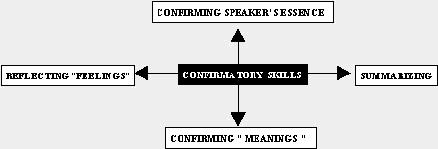
Thus , listening skills not only enable a person to comprehend and retain
what has been shared but also enable more and better transfer of perception.
This has a further impact on relationship goals such as demonstrating
care and achieving alignment.