Outbound training as a medium of training
has been gathering momentum for the last 2-3 years. Organizational personnel
who get a whiff of it being conducted by the organizations , strive to
be included among the participants and kick up dust , if not included.
The question that arises
is " Why the interest in outbound training while it takes wild horses to
pull them to other training programmes".
Is it because the
participants sense an enjoyable holiday in the hills during summer or is
there something more to it ?
On the trainer's
side , there are some who utilize the external environment for creating
simulations in order to enable learning while there are others who leave
the participants at a distance from camp , ask them to trek to the camp
and thereafter call it experiential learning.
Outbound
training as a process of learning has immense potential , provided we are
able to tap it. The outbound training environment is rich in uncertainty
and change , thus being a better simulator of the actual work environment
as compared to a class - room which operates under controlled conditions.
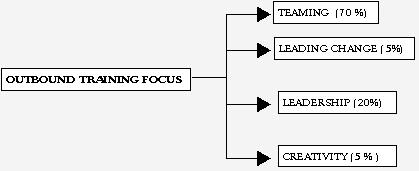
FOCUS OF OUTBOUND TRAINING :
Most of the current outbound
training programmes are focussed on " BUILDING HIGH PERFORMING TEAMS".
However , some organizations have experimented with this training methodology
for programmes on LEADING CHANGE , LEADERSHIP AND CREATIVITY.
The excitement associated with outbound training programmes reflects some
sort of need satisfaction of participants . The drawback of class room
workshops is that most of the learning is conceptual , while in outbound
training programmes , experiential learning occurs.
Additionally , learning is directly linked
to a recent team or individual action , which increases the fun of learning.
This shift in mental patterns of participants from " LEARNING IS BORING"
to " LEARNING IS FUN" is the root cause of their willingness to attend
such programmes. Says the head of H.R of a leading multinational ," I have
100 nominations for an outbound training programme " .
THE LEARNING PROCESS :
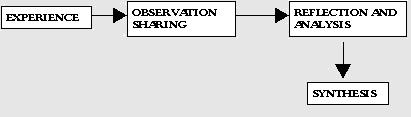
For experiential learning to happen , the team or individual experience
has to be followed up by observations sharing , reflections and analysis.
In order to catalyse experiential
learning , a formal review has to be conducted by the facilitator , after
every major experience or exercise. Facilitation triggers have to be used
to extract learning principles and practices.
A
facilitation trigger is given below :
1. When and where did you see lack of alignment in the team ?
2. What team process would have insured team alignment at that stage
?
3. Has it improved team performance ?
Synthesis
of these querries , in the form of the principles , processes and skills
has to be consolidated by the participants on worksheets,designed for the
purpose. This catalyses the perception building and internalization of
learning.
The process of competence development is given below :

DESIGN OF THE OUTBOUND PROGRAMME :
The design of the exercises in the outbound
programme should revolve around the real life characteristics of the work
place. These exercises need to be firmly distinguished from , "SPORTS",
in as much as , that in sports everybody starts equal but that is not so
in real life. Therefore , in these exercises we need to have teams striving
towards the same objective with :
1. Unequal resources
2. Rapid change in information availability.
3. Risk
4. uncertainty
5. Wrong information
The outbound environment
is excellent for building these characteristics into the team exercises.
The subsequent
reviews enable the extraction of principles and processes which can be
transferred to the work place.
The
current outbound training programmes which focus on trekking ,rappling
, mountain climbing,river crossing etc. without a focus on extraction of
learning and its subsequent transfer to the workplace may not be useful.